We are your neighborhood farmer

We are your neighborhood farmers -- Get in touch at 707 347-9465 or wmorgenthaler@gmail.com

Tuesday, February 13, 2018

Western Thimbleberry, Rubus parviflorus

Western Thimbleberry, Rubus parviflorus:

recommended as better than salmonberry by paul odonnel


Rubus parviflorus (Thimbleberry) is a species in the Rosaceae (Rose) family native to western and northern North America, from Alaska east to Ontario and Michigan and south to northern Mexico. It is widespread in California. It grows from sea level in the north, up to 2,500 meter altitude in the south of the range. It is a dense shrub up to 2.5 meter tall with canes 3-15 millimeter diameter, often growing in large clumps which spread through the plant's underground rhizome. Rubus is the genus of raspberries and blackberries, but unlike most other members of the genus, it has no thorns. The leaves are palmate, 5-20 centimeter across, with five lobes; they are soft and fuzzy in texture. The flowers are 2-6 centimeter diameter, with five white petals and numerous pale yellow stamens. It produces a tart edible composite fruit 10-15 millimeter diameter, which ripen to a bright red in mid to late summer. Like other raspberries it is not a true berry, but instead an aggregate fruit of numerous drupelets around a central core; the drupelets may be carefully removed separately from the core when picked, leaving a hollow fruit which bears a resemblance to a thimble, perhaps giving the plant its name; it is also said that it may get its name from the Thimble Islands in Connecticut, though it is rarely seen there.

 "Rubus parviflorus"


'via Blog this'

Morus alba - Russian Mulberry

Morus alba - Tehran.JPG


Morus alba - Wikipedia:

On young, vigorous shoots, the leaves may be up to 30 cm long, and deeply and intricately lobed, with the lobes rounded. On older trees, the leaves are generally 5–15 cm long, unlobed, cordate at the base and rounded to acuminate at the tip, and serrated on the margins. The trees are generally deciduous in temperate regions, but trees grown in tropical regions can be evergreen. The flowers are single-sex catkins; male catkins are 2–3.5 cm long, and female catkins 1–2 cm long. Male and female flowers are usually on separate trees although they may occur on the same tree.[10][11] The fruit is 1–2.5 cm long; in the species in the wild it is deep purple, but in many cultivated plants it varies from white to pink; it is sweet but bland, unlike the more intense flavor of the red mulberry and black mulberry. The seeds are widely dispersed in the droppings of birds that eat the fruit.[3][4][12]

The white mulberry is scientifically notable for the rapid plant movement involved in pollen release from its catkins. The stamens act as catapults, releasing stored elastic energy in just 25 µs. The resulting movement is approximately 350 miles per hour (560 km/h), over half the speed of sound, making it the fastest known movement in the plant kingdom.[9]"


'via Blog this'

Peas for apple trees

These are part of the organic plow down mix and I am using them aroung the base of apple trees to crowd out grass and vine into the tree for support.  This will cool the trunk in the hot sun and also feed the tree.  We are using all three peas together, mangus, biomaster and dundale.  I may use one or other in some locations to test the variety.

Magnus Peas - Hearne Seed:

"Magnus peas are an annual legume used to produce organic matter & nitrogen, or as forage.  They do best when mixed with cereal grains and/or legumes which they use for support to climb on with thier upward growth.  As a cover crop they break down quickly after incorperation and can produce high amounts of nitrogen, this nitrogen can be available to the subsequent cash crop.  Magnus Peas are not winter dormant and grow rapidly through the winter producing more biomass earlier than winter dormant type peas.  They can get winter killed in cold climates."

Biomaster peas:

 "Biomaster peas are a fast-growing , proprietary  peas developed for outstanding forage and biomass production. Biomasters are a strong veining pea with large leafs and pink flowers. It is a very fast growing pea with most production made within 45-60 days after planting. Because of its rapid growth, it is an excellent plow down crop producing high amounts of nitrogen for subsequent cropping seasons. University trials have shown Biomasters to be one of the top nitrogen fixing legumes as well as produces  higher yields compared to other fall grown peas. Biomaster peas are a must for any cover crop/green manure crop"

Dundale Peas - Hearne Seed:

 "Dundale peas are an annual legume used in cover crops to produce organic matter & nitrogen, or as forage.  They do best when mixed with cereal grains and/or legumes; they use the other plants for support to climb on with thier upward growth.  As a cover crop they produce nitrogen by symbiotic association, this nitrogen can be available to the subsequent cash crop."

'via Blog this'

Apple Tree Guild

Guild, or companion, planting is one of the fundamental techniques of permaculture gardening. It taps into permaculture ideas such as self-sufficient systems, plants providing multiple functions, and maximizing the productivity of a plot. Guilds are typically set up around a central fruit tree. Each plant species in the ecosystem performs one or more functions that benefit others in the vicinity, as well as interacting with animal species and soil microorganisms to create an ecosystem. Below are examples of species that can be used to make an effective guild planting around an apple tree.

following are three good discussions

Monday, February 12, 2018

Hibiscus syriacus - Plant Finder


Hibiscus syriacus - Plant Finder: "Easily grown in average, medium moisture, well-drained soils in full sun to part shade. Best flowering occurs in full sun. Prefers moist, organically rich soils, but tolerates poor soils and some drought. Very tolerant of summer heat and humidity. Generally tolerant of urban conditions. Prune to shape in spring. Pruning back to 2-3 buds in late winter may produce larger blooms. Easily propagated by stem cuttings. May be grown from seed, but seedlings may not have the exact same flower color as the parent. Species plants can self-seed aggressively in optimum growing conditions.

Noteworthy Characteristics
Hibiscus syriacus, commonly called rose of Sharon or shrub althea, is a vigorous, upright, vase-shaped, multi-stemmed, deciduous shrub that typically grows 8-12’ tall. It may be trained as a small tree or espalier. Showy, hollyhock-like, 5-petaled flowers (to 3” diameter) appear over a long, early-summer to fall bloom period. Each flower has a prominent and showy center staminal column. Palmately-veined, coarsely-toothed, three-lobed, medium green leaves (to 4” long) are attractive during the growing season but produce no fall color."


'via Blog this'

Sunday, February 11, 2018

Hugelkultur: Building wood berms In the hedgerow- The Permaculture Research Institute


Step two in the hedgerow plan:

Turning waste unprocessed brush and limb on the Oasis Farm in to valuable soil. Interested in helping build one of these. There is no better time than the end of winter to build a bunch of these.  Over a short time this biomass will become the forest floor for the hedge.  By placing them down hill of our plantings we can actually build forest floor as our hedgerow grows overhead using all of our woody and brush waste in the future thus storing the nutrient in the soil. This is one of those long haul projects as we have 4 years of brush piled up.  That's a lot of soil!


This link below goes to a wonderful step by step methodology.  Very impressive presentation showing installations.  Ours will be a modified one of these because of the type of material.


Hugelkultur: Composting Whole Trees With Ease - The Permaculture Research Institute:


"Hugelkultur is a composting method that uses large pieces of rotting wood as the centerpiece for long term humus building decomposition. The decomposition process takes place below the ground, while at the same time allowing you to cultivate the raised, or sunken, hugelkultur bed. This allows the plants to take advantage of nutrients released during decomposition. Hugelkultur, in its infinite variations, has been developed and practiced by key permaculture proponents such as Sepp Holzer and Masanobu Fukuoka for decades."


'via Blog this'

Saturday, February 10, 2018

OpenSprinkler Pi (OSPi) — Sprinkler / Irrigation Extension Board for Raspberry Pi « RAYSHOBBY.NET

This is a possible way forward so Arlo and I can be on the same page with irrigation.  It is also trainable and transferable to others who are less skilled because it is web based.

OpenSprinkler Pi (OSPi)

This system requires the internet in order to program and manually manipulate the stations.  It also provides an ap for using a smart phone to do this work.  This will come in handy for troubleshooting a large complex irrigation system such as we have. Replacing the old Toro controllers with Open Sprinkler Pi does ads some cost but does not actually increase work as we are under capacity already and the addition of an upper zone for hedgerow makes work necessary.  Open Sprinkler would also unify the controller in a new location under the Barn front porch and will require the addition of new 20 conductor control wires from barn to oven valve location and additionally a 13 conductors from the oven to old hoop house location.  This is needed so we have control to the upper orchard area and the lower garden, butterfly garden, chickens, house and fig area.  This is a total of 18 stations whereas we now have only 11 of which 5 are down due to the waterline brake last year.  Hence it makes since to make this change before summer as work will have to happen anyway, otherwise we risk crop and tree failure such as what happened to the figs last year.


We will need both the basic and the expansion which give us a 24 zone capacity also a new Pi so total of $162  where as the Toros are $70 each. The job will require minor trenching, conduit and wire which will perhaps another $50.


Other possible integrations may be path lighting, landscape pumps and irrigation pumps which will enable future economies.


 . OpenSprinkler Pi (OSPi) — Sprinkler / Irrigation Extension Board for Raspberry Pi « RAYSHOBBY.NET:


'via Blog this'

Thursday, February 8, 2018

California Wax Myrtle, Morella californica

California Wax Myrtle, Morella californica:

This is a fast growing tree if you water it a lot.  it is weak soft wood  and so best grown multi trunked according to master gardeners this would like afternoon shade that the location at the steps of the barn will afford and so will substitute for the Calif. Bay


Image result for California Wax Myrtle

"California Wax Myrtle (Morella californica) is a native shrub in the Myracaceae (Myrtle) family that is found primarily along the coast in northern and central California, although it does occur as far south as Los Angeles County and as far north as British Columbia. It is moderately fast growing and long-lived. It grows in an upright form to a height of 33 feet, with active growth during the spring and summer. Flowers are yellow and bloom in the early summer. Leaves are lanceolate, dark green, and remain on the plant throughout the year. It tends to grow in dunes, hills and woodlands at elevations from sea level to 2,000 ft. This species makes an excellent small garden tree, especially in coastal gardens or inland if given slightly more moisture and afternoon shade."

at the master gardeners this is called pacific wax myrtle,  Myrica californica  same tree name change


'via Blog this'

Salsa Guild including nasturtiums tomatoes basil and peppers

There is much more on this site than this one garden idea.


https://permacultureplantdata.com/index.php?option=com_content&view=article&id=488&Itemid=237

Thursday, February 1, 2018

Toyon Heteromeles arbutifolia

Heteromeles arbutifolia, Toyon:


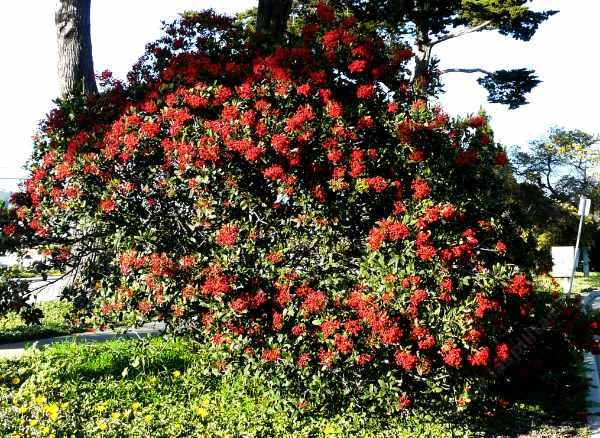
Christmas berry or Toyon with berries is what Hollywood was named after. Toyon will grow in most of Los Angeles with no water after first year. "Toyon, or as it's sometimes called, Christmas Berry, is an evergreen shrub to small tree that usually grows to 6-8 ft. high and 4-5 ft. wide. Toyon can go to 15-20' tall if it's old and happy and become a delightful evergreen multi-stemmed tree with white flowers in summer and red berries in winter.

Toyon makes a good screen or specimen plant.

Toyon is native to much of California, with a few plants wandering over the Oregon border. Don't get excited it was on a mile or so. Heteromeles is drought tolerant after the first few years, but tolerates some water if drainage is good. Relatively fire resistant, (a non-watered Toyon is about the same as a watered apple tree). Toyon likes full sun, but  tolerates full shade. Tolerates serpentine based adobe soils, but also lives in beach sand. The berries are kinda edible but awful and contain cyanide compounds that can kill you if you eat a few pounds. Better for the birds. I had one student make a cherry pie out of them that wasn't bad. (The same cyanide compounds volatilize off and leave the cherry flavor when cooked.)"


'via Blog this'