
"Known by the common name California buckwheat. This common shrub is native to the southwestern United States and northwestern Mexico, where it grows on scrubby slopes and in chaparral and dry washes in a number of habitats. It is variable in appearance, forming a patchy, compact bramble or a spreading bush approaching two meters in height and three across. The leaves grow in clusters at nodes along the branches and are leathery, woolly on the undersides, and rolled under along the edges. Flowers appear in dense, frilly clusters which may be anywhere from a few millimeters to 15 centimeters wide. Each individual flower is pink and white and only a few millimeters across. This plant is particularly attractive to honey bees and is a good source of nectar over many months in drier areas.
There are four recognized varieties of California Buckwheat: 1. Eriogonum fasciculatum var. foliolosum or Leafy California Buckwheat, a brighter green variety which grows primarily on the coast and western side of the coastal mountain ranges, and is often carried in nurseries, 2. Eriogonum fasciculatum var. polifolium, a gray variety which grows primarily in the desert regions and through the coastal foothills, and is sometimes available in nurseries, 3. Eriogonum fasciculatum var. fasciculatum, or Coastal California Buckwheat, which grows most closely to the coast, and 4. Eriogonum fasciculatum var. flavoviride, or Sonoran Desert California Buckwheat, which grows primarily in the Sonoran Desert and desert mountains.
California Buckwheats are tough and easy to grow, even in very dry conditions. Plant in a well draining sunny site. It shouldn't need supplemental water after established, but it will tolerate occasional summer water better than most extremely drought tolerant California natives. Form is variable, ranging from often open and upright in the foothills, to often dense and mounding closer to the coast. It produces profuse pink to white and cream-colored flowers as early as March that dry to a pretty red rust color as the soil dries. It sheds its dried flowers and a significant portion of its small blade-like leaves each dry season, and is an important plant for creating natural mulch. California Buckwheat is a keystone species for sagebrush scrub ecosystems, and a great choice for wildlife and butterfly gardens. Low growing forms of both Leafy Green Buckwheat and Interior California Buckwheat can be found in nurseries to use as spreading ground covers."
'via Blog this'


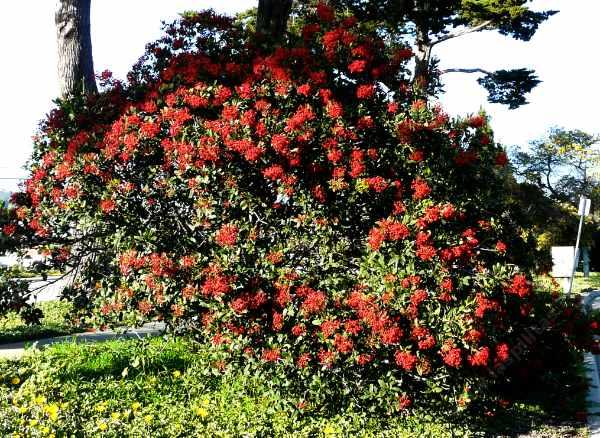 "Toyon, or as it's sometimes called, Christmas Berry, is an evergreen shrub to small tree that usually grows to 6-8 ft. high and 4-5 ft. wide. Toyon can go to 15-20' tall if it's old and happy and become a delightful evergreen multi-stemmed tree with white flowers in summer and red berries in winter.